 Corpus.Core
Pragmatic Adaptive Privacy (PAP)
If we are honest, privacy was not a primary design goal of Bitcoin and Ethereum, which have shaped most of today’s Web3 infrastructure.
Why Privacy Maximalism Fails, and How Pragmatic Adaptive Privacy Changes Web3

TL;DR
- Web3 has robust privacy technologies, but it lacks** built-in, general privacy** , particularly when** reading** blockchain state. Most privacy leaks happen** before transactions** , through RPC-based reads that expose identity and intent.
- Pragmatic Adaptive Privacy (PAP)treats privacy as an** engineering decision under constraints** , not an ideology: privacy is applied** on a per-read basis** , based on risk, cost, and usability.
- By separating** transport privacy (who is asking)from content privacy (what is being inferred)and using a simple T × C model** , PAP enables meaningful privacy gains without maximal overhead.
- A** Privacy Abstraction Layer (PAL)**enables deployment by moving complexity out of applications and enforcing adaptive, trustless read privacy at the protocol level.
- Privacy that is usable, composable, and verifiable can scale. Privacy maximalism cannot.
Introduction
If we are honest, privacy was not a primary design goal of Bitcoin and Ethereum, which have shaped most of today’s Web3 infrastructure.
Web3 was built around transparency, global verifiability, and trustless execution. These properties are powerful — and they are deliberately public. Privacy, in contrast, has been retrofitted by the ecosystem, often treated as a moral imperative rather than as a system property with real costs.
This mismatch creates a problem. On the one hand, the lack of privacy makes real-world use fragile, strategically exploitable, and, in some cases, outright dangerous. It also creates regulatory tension, as transparent-by-default systems tend to leak more user data than is necessary or justifiable in many jurisdictions.
On the other hand, strong privacy mechanisms are expensive. They introduce latency, consume bandwidth, require additional infrastructure, and degrade user experience. In practice, this often puts teams in a difficult position: choosing between regulatory exposure and systems that are too slow, too complex, or too costly to deploy at scale. The result: privacy is sacrificed in favor of convenience, performance, and cost.
The usual response has been privacy maximalism: applying the strongest possible privacy guarantees everywhere, by default. In practice, this approach prevents systems from being used at all. Developers avoid it. Users disable it. Products revert to insecure yet convenient defaults.
Meanwhile, privacy is already lost long before a transaction is sent. Every interaction with a blockchain begins with reading data. In practice, these reads are almost always routed through centralized RPC gateways.
These gateways collect connection metadata, such as IP addresses, timing, and request patterns, and observe precisely which data users are interested in. Reads are frequent, unavoidable, and highly revealing — often leaking intent more clearly than the transaction itself.
Pragmatic Adaptive Privacy (PAP) starts from a simple premise: privacy must be usable to be effective. Rather than maximizing global privacy, PAP applies the appropriate level of privacy to each action, based on context, risk, and cost.
Discussions about privacy in Web3 almost always gravitate toward transactions. Front-running, MEV, private mempools, mixers, and shielded transfers dominate the debate. This focus is understandable but incomplete.

Privacy Leaks Happen Before Transactions
Every interaction with a blockchain can be separated into three phases:
- Transport : How requests are delivered to the network
- Read : Which pieces of state are accessed
- Write : Which transactions are submitted
Most privacy mechanisms concentrate on the write phase. By the time a transaction is broadcast, however, a significant amount of information has already been revealed through transport- and read-level interactions.
Full Nodes and the Limits of Local Read Privacy
If a user operates their own full node, read privacy is straightforward. All blockchain data is available locally. No queries leave the system, no metadata is exposed, and no third party can observe what is being read or when. This model, however, does not generalize.
Running a full node requires storage, bandwidth, continuous availability, and operational effort. For most users — and especially for applications — this assumption does not hold. Wallets, dApps, bots, AI agents, and IoT devices cannot rely on every user maintaining their own node.
As a result, blockchain access is almost always mediated through remote interfaces. Even when stateless or light clients are used to locally verify responses, the underlying data is still fetched from external sources. Verification replaces trust, but it does not eliminate metadata exposure.
Local read privacy is therefore theoretically achievable but rarely available in practice.
Transport: Who Is Asking
Almost all applications today access data from Ethereum and other L1 and L2 chains through RPC endpoints. In practice, this usually means centralized RPC gateways operated by a small number of infrastructure providers.
These gateways observe connection-level metadata, including IP addresses, timing, request frequency, and request sequences. Even without inspecting request payloads, this metadata is sufficient to construct detailed and persistent usage profiles. Wallets, applications, and sessions can often be correlated over time.
From a privacy perspective, this means that querying the chain already reveals who is asking , regardless of whether a transaction is ever submitted.
Read: What Is Being Prepared
Reading blockchain state via RPC interfaces is not a neutral operation. Reads are highly semantic and context-dependent:
- balance checks
- allowance queries
- pool state lookups
- price queries and transaction simulations
Taken together, they reveal intent. In many cases, read patterns expose what a user is about to do more clearly than the eventual transaction itself.
This creates an underappreciated risk. Observers with visibility into read activity can infer trading strategies, anticipate large transactions, or prepare front-running and sandwich attacks—even if the final transaction is subsequently protected or obfuscated.
Write: The Visible Endpoint
Transactions are public by design. The sender, target contract, calldata, and execution effects are visible on-chain, and often observable in the mempool before inclusion.
This is where most privacy discussions traditionally begin. By this point, however, much of the relevant information may already be known. Transport metadata and read-level intent leakage can be sufficient to identify actors and predict actions, even if the transaction itself is partially shielded.
Privacy leaks in Web3 do not start at the transaction layer. They begin earlier, during transport and read operations. Ignoring these phases creates a false sense of security and leads to privacy solutions that address symptoms rather than causes.
Any serious approach to privacy must therefore begin with reads, not writes.

Two Fundamental Privacy Questions
Once it becomes clear that privacy leaks originate during transport and read operations, a more precise question follows: what exactly needs to be protected?
Many discussions of privacy in Web3 implicitly conflate different problem classes. As a result, proposed solutions are often expensive, ineffective, or misapplied. To reason about privacy in a technically meaningful way, two fundamentally different questions must be separated.
Who Is Acting?
The first question concerns identity :
Who is making a request, interacting with an application, or preparing an action?
This dimension covers all forms of linkability and attribution, including:
- IP addresses and other network identifiers
- timing and frequency of requests
- correlation across sessions, wallets, and applications
An observer who can answer this question can construct persistent usage profiles, even without understanding the content of individual requests. Importantly, protecting identity is primarily a transport-layer problem, and even simple measures, such as using multiple RPC providers with non-predictable switching, can already reduce linkability without providing full anonymity.
What Is Being Done?
The second question concerns intent :
What is being read, queried, or inferred from the interaction?
This dimension is revealed through the semantics of read operations:
- which pieces of state are accessed
- in what sequence
- how individual readings relate to one another in context.
Even if identity is partially obscured, an observer who can interpret read patterns may still infer strategies, positions, or upcoming actions. Protecting intent is therefore a content-level problem. It requires abstraction, aggregation, or cryptographic techniques that reduce semantic visibility.
Why These Questions Must Be Treated Independently
These two dimensions are orthogonal. Protecting identity does not automatically protect intent. An anonymous user repeatedly querying the same pool state may still reveal a trading strategy. Conversely, hiding intent does not guarantee anonymity if all requests are routed through a stable, linkable transport path.
Many privacy systems fail because they blur this distinction. They optimize heavily along one dimension while leaving the other exposed, creating a false sense of security and unnecessary cost, or maximizing both with high direct or indirect costs make the solution impractical.
A rigorous privacy model must therefore treat who and what as separate axes. Only then does it become possible to reason about trade-offs, costs, and appropriate levels of protection.
Read Privacy vs. Write Privacy
Privacy in Web3 is often discussed as a single problem. In practice, however, reading from the blockchain and writing to it expose fundamentally different information and require different approaches.
Failing to separate these two leads to misplaced solutions: heavy mechanisms applied in places where they add limited value, while critical leaks remain unaddressed where they matter most.
Write Privacy: Important, but Not the Focus Here
Writing to the blockchain means submitting a transaction that changes state. By design, this process is public. The sender, target contract, calldata, gas parameters, and execution effects are visible on-chain and often observable in the mempool before inclusion.
This visibility creates well-known risks, including front-running, sandwich attacks, and MEV extraction. As a result, a substantial ecosystem of write-privacy mechanisms has emerged, including mixers, shielded pools, private transaction frameworks, and encrypted mempools.
These systems are important and necessary. They address a real and well-understood problem space. However, they are explicitly focused on the write phase.
Within the PAP framework, the focus is not to replace or compete with these systems, but to address read privacy as a first-class concern through pragmatic, practical approaches.
Read Privacy: The Overlooked Problem
Reading blockchain data is an off-chain operation. It does not modify state, does not require consensus, and is often assumed to be harmless.
In reality, read operations are frequent, unavoidable, and highly revealing. Wallets, dApps, bots, AI agents, and IoT devices constantly query balances, allowances, contract state, and pricing information. These reads are typically executed over RPC interfaces and routed through a small number of infrastructure providers.
As discussed earlier, read patterns are semantic. They expose interests, strategies, and upcoming actions. In many cases, the intent revealed by read sequences is clearer than that inferred from the final transaction alone.
Why Write Privacy Is Not Enough
A common assumption is that protecting transactions is sufficient. If the write is private, the reasoning goes, the user is protected. This assumption is flawed.
If read activity remains observable, an attacker may already know what will happen before the transaction is ever sent. Even a perfectly private transaction cannot undo intent leakage that occurred during preparation.
Write privacy without read privacy therefore provides, at best, partial protection.

The T × C Privacy Model
With the relevant privacy dimensions clearly separated, read privacy can be described in a structured and operational way. PAP models read privacy along two independent axes: Transport (T) and Content (C).
The goal of this model is not to maximize privacy everywhere, but to make privacy selectable, comparable, cost-aware, and pragmatically applicable.
Two Independent Axes
The T × C model directly maps to the two fundamental questions introduced earlier:
- Who is acting? → Transport (T)
- What is being read or inferred? → Content (C)
Each axis is discretized into three levels. The levels are intentionally coarse-grained. They are designed to support practical decision-making rather than to exhaustively classify all possible privacy techniques.
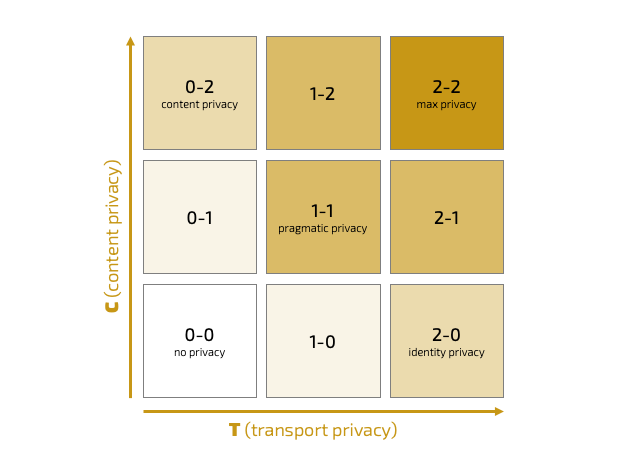
Transport Privacy (T)
Transport privacy refers to how easily readable activity can be linked to a specific actor over time.
- T0 — Linkable
Read requests follow stable, directly linkable transport paths. Long-term correlation and attribution are straightforward. - T1 — Correlation-Resistant
Read requests are distributed across multiple paths or providers. Linkability is reduced, but attribution remains possible. - T2 — Strongly Decoupled
Read requests are routed in a way that makes persistent attribution impractical under realistic threat models.
Improvements along the transport axis primarily reduce identity leakage. They are often incremental and relatively inexpensive compared to content-level protections.
Content Privacy (C)
Content privacy refers to the extent to which intent can be inferred from read operations themselves.
- C0 — Explicit
Reads expose concrete state and semantics directly. Intent is immediately visible. - C1 — Abstracted
Reads are partially aggregated or abstracted. Intent may still be inferred, but with reduced confidence. - C2 — Opaque
Reads are structured to significantly limit semantic interpretation. Intent inference is minimized.
Improvements along the content axis primarily reduce intent leakage. They are typically more expensive and should therefore be applied selectively.
The Matrix
Combining both axes yields a simple 3 × 3 matrix. Each read operation occupies exactly one point in this space.
Crucially, the matrix is not a ranking. Moving toward higher privacy levels always entails trade-offs among latency, bandwidth, complexity, and usability. PAP treats the matrix as a design space rather than as a ladder that must always be climbed.
Why This Model Matters
Without an explicit model, privacy discussions tend to collapse into vague demands for “more privacy.” The T × C model replaces this with concrete, comparable choices:
- Which dimension is relevant for this action?
- Which level is sufficient in this context?
- What cost is acceptable?
This framing makes privacy decisions explicit and reviewable. It is a prerequisite for pragmatic system design and for integrating privacy into real-world applications.

Why Privacy Maximalism Fails
The T × C model makes one constraint explicit: stronger read privacy always comes with a higher cost. In the context of Ethereum and other programmable blockchains, ignoring this constraint leads to a recurring pattern — privacy mechanisms that are theoretically strong but practically unusable.
This is not an argument against strong privacy techniques. Many of them are well-researched, cryptographically sound, and highly effective in isolation. The problem arises when they are treated as universal defaults for blockchain read access under strict trustlessness assumptions.
Strong Read-Privacy Techniques Exist
Several classes of techniques aim to provide near-maximal content privacy for reads:
- PIR (Private Information Retrieval) hides which item is retrieved from a database.
- ORAM (Oblivious RAM) hides access patterns by ensuring that all reads and writes appear indistinguishable to the storage provider.
- zk-based query abstraction replaces raw data access with proofs over predicates or properties of state (e.g., proving that a balance satisfies a condition without revealing the balance itself).
- Trusted Execution Environments (TEEs) execute read operations within hardware-enforced enclaves, so that neither access patterns nor content are visible to the host system.
All of these approaches can provide very strong content-level privacy. From a pure privacy perspective, they represent the upper end of the C-axis.
Why This Becomes Hard on Ethereum and L2s
Blockchain reads differ fundamentally from traditional database queries. In practice, reads must satisfy several constraints simultaneously:
- Freshness : data must be associated with a recent, well-defined chain state.
- Verifiability : responses must be provably correct with respect to consensus and execution state. In PAP terms, trustlessness is non-negotiable — privacy must not be achieved by reintroducing trusted intermediaries or weakening verification.
- Scalability : latency, bandwidth, and computation must remain acceptable for wallets, dApps, bots, mobile clients, and IoT devices.
PIR- and ORAM-style approaches are expensive along multiple dimensions:
- Bandwidth overhead grows significantly as indistinguishability sets increase.
- Latency increases due to additional rounds and increased computational complexity.
- Computation and infrastructure requirements are high on both the client and server sides.
These costs are already challenging in Web2 systems. In Ethereum and L2 environments, they directly conflict with the requirement for trustless verification.
The Trustlessness Tension
Under a trustless model, clients cannot rely on a server’s statement about the data. They must verify that returned data corresponds to a specific chain state.
This introduces a structural tension:
- Verification requires proofs tightly coupled to the accessed state.
- Maximal privacy requires access patterns to be indistinguishable.
As a result, systems face a trade-off. Either verification becomes expensive because proofs must cover many possible states, or privacy weakens because proofs reveal which state was actually accessed.
Some designs mitigate this tension, but none remove it without cost. For most mainstream blockchain use cases, “maximum privacy by default” is therefore not a realistic goal.
Why Maximalism Backfires
When read-privacy mechanisms are too slow, too expensive, or too complex:
- Developers avoid integrating them
- Products disable them by default for performance reasons
- Users fall back on trusted gateways without privacy for convenience
The result is a paradox : strong privacy exists in theory, yet most real-world interactions remain highly observable.
Pragmatic Adaptive Privacy starts from this observation. Instead of treating maximal privacy as a baseline, it treats strong techniques as tools to be applied selectively, with their cost justified by the associated risk.

Pragmatic Adaptive Privacy (PAP)
Pragmatic Adaptive Privacy addresses the core failure of both privacy maximalism and privacy minimalism. Instead of treating privacy as a binary property, PAP treats it as a design parameter that can be adjusted per action.
The central observation is straightforward: not all reads carry the same risk, nor do they justify the same cost. Applying a single privacy level across all contexts either wastes resources or leaves critical interactions exposed.
PAP therefore applies privacy on a per-read basis , based on context, intent, and cost. PAP treats privacy as an engineering decision under constraints, not as an ideological goal.
Pragmatism as a Design Pattern
In PAP, pragmatism is not a compromise. It is a design pattern.
Pragmatic privacy means deliberately avoiding two extremes. On the one hand, PAP avoids applying more privacy than is justified for a given read. Overprotecting routine operations wastes resources and degrades usability. On the other hand, PAP also avoids treating maximal techniques as the only meaningful form of privacy.
Instead, PAP explicitly employs intermediate techniques , particularly in the C1-C2 range. These techniques do not aim for perfect indistinguishability, as approaches like PIR or ORAM do. Rather, they aim to reduce semantic leakage to a level sufficient for the specific risk at hand.
This includes methods such as abstraction, aggregation, batching, partial disclosure, or deliberately limiting semantic resolution. While these approaches provide less theoretical privacy than maximal constructions, they often deliver a far better cost–benefit ratio in real systems.
The same pragmatic reasoning applies to transport-level protections across T1 and T2.
Crucially, this form of pragmatism is intentional. It acknowledges that privacy is not a binary property, but a spectrum, and that meaningful protection can be achieved without pushing every read to the most expensive extreme.
Resource Awareness on the Client Side
Privacy is not only costly at the protocol level. It also consumes resources on the client side.
Wallets, browsers, mobile apps, bots, and IoT devices operate under strict constraints:
- limited CPU and memory
- limited bandwidth
- battery and energy constraints
- latency-sensitive user interfaces
PAP explicitly accounts for these constraints. Privacy mechanisms that significantly increase client-side resource usage impose real costs, even if no explicit fee is paid. These costs must be justified by the sensitivity of the read operation.
Strong privacy that renders applications slow, unstable, or unusable is self-defeating.
PAP as a Framework, Not a Feature
PAP is not a single mechanism or protocol. It is a framework for reasoning about read privacy choices.
However, a framework alone is not enough. In practice, applications are reluctant to integrate complex privacy logic directly. Every additional privacy mechanism increases code complexity, maintenance effort, and the risk of subtle bugs. Supporting multiple techniques often leads to fragmented implementations and duplicated logic across wallets and dApps.
This is where the Privacy Abstraction Layer (PAL) becomes critical.
The Privacy Abstraction Layer (PAL)
The Privacy Abstraction Layer shifts privacy complexity from application code to a dedicated protocol layer.
From the perspective of a wallet or dApp, reads look the same as they always have. The application issues standard read requests without embedding privacy-specific logic or cryptographic machinery.
PAL sits below the application and translates these reads into concrete PAP strategies based on context:
- evaluating the required position in the T × C space
- selecting appropriate transport and content mechanisms
- enforcing trustless verification guarantees
This separation has important consequences:
- Applications remain simple and maintainable
- Privacy techniques can evolve independently of application logic
- Multiple privacy strategies can coexist without fragmenting the ecosystem
PAL does not hide trade-offs. It makes them explicit and enforceable at the protocol level, while allowing applications to benefit from adaptive privacy without becoming privacy experts themselves.
What matters is not the specific mechanism used, but that privacy decisions are applied consistently, transparently, and where appropriate.
Without a Privacy Abstraction Layer, PAP remains simply a theory. With it, privacy becomes deployable.

From PAP to Adoption: Colibri as a Privacy Abstraction Layer
The limiting factor for read privacy in Web3 is not cryptography, but deployability. Applications are constrained by performance, resources, maintenance effort, and developer capacity. Any privacy approach that significantly complicates application code or imposes heavy overhead will fail to reach mainstream usage.
PAP becomes actionable only when paired with an architecture that makes pragmatic privacy easy to adopt.
Adoption Requires Pragmatic Privacy
In practice, the largest privacy gains can be achieved without aiming for maximal constructions. Instead, PAP focuses on making moderate but effective privacy levels widely available.
Concretely, this means prioritizing:
- T1 and T2 transport methods , which reduce linkability and long-term correlation without excessive latency or infrastructure cost
- C1 content methods , which limit semantic and intent leakage through abstraction, aggregation, batching, or reduced resolution
These approaches do not provide perfect indistinguishability, but they deliver substantial privacy improvements at a fraction of the cost of maximal techniques. This makes them suitable as defaults for real-world applications.
Concretely, these levels can be realized in different ways. The following mechanisms are illustrative examples rather than an exhaustive list:
- T1 can be achieved by distributing read requests across multiple RPC endpoints. Queries that would otherwise reveal identity or intent when correlated are deliberately distributed across providers, reducing linkability without imposing significant transport overhead.
- T2 builds on this by decoupling transport entirely, for example, by routing requests through anonymity networks such as Tor. This makes long-term attribution significantly more difficult, at the expense of increased latency.
- C1 is achieved by restructuring reads so that applications fetch a broader set of data than strictly required. The larger data package is verified using proofs, while the PAL extracts only the relevant information locally. This reduces semantic and intent leakage without resorting to maximal techniques like PIR.
These mechanisms are intentionally composable. They form a modular toolbox that can be combined per read operation. Different calls may employ different combinations of transport paths and content strategies, allowing privacy to be selectively strengthened across requests without imposing a single global mode.
The Role of the Privacy Abstraction Layer (PAL)
The Privacy Abstraction Layer ensures that these pragmatic privacy methods are available without burdening application developers.
Applications issue standard read requests. PAL applies the PAP policies below to the interface, selecting appropriate T1/T2 and C1 mechanisms and enforcing trustless verification guarantees.
By concentrating privacy logic at the protocol level, PAL enables:
- consistent privacy behavior across applications
- evolution of privacy techniques without application changes
- resource-aware execution for mobile, web, and IoT environments
Colibri.stateless as an Enabler
Colibri.stateless realizes PAP and PAL as a stateless, verifiable read-access layer for Ethereum and compatible chains.
Rather than optimizing for maximal privacy, colibri.stateless focuses on making pragmatic, low-overhead privacy accessible by default. By emphasizing T1, T2, and C1 techniques, it opens meaningful privacy protections to a wide class of applications that would otherwise rely on fully observable RPC access.
Colibri does not require applications to change how they think about reads. It changes how reads are executed.

Conclusion
Web3 has working privacy technologies. Privacy coins, shielded protocols, and specialized systems demonstrate that strong privacy is achievable. What Web3 lacks, however, is general, default privacy across everyday interactions.
In fact, most privacy leaks do not occur during transaction broadcasting. They occur earlier, during reads. Balance checks, state queries, and preparatory calls leak intent and metadata well before a transaction is created.
This problem is based on how Web3 is actually used. If every application and every user operated their own full node, most read privacy issues would disappear. In reality, this is not the case. The vast majority of applications rely on RPC services to access blockchain state. These services simplify access and lower barriers to entry, but they also centralize read traffic and expose metadata that enables correlation, profiling, and intent inference.
There is a growing body of research and practical work on strong read-privacy techniques, including approaches that are well studied in theory and successfully deployed in non-blockchain systems. But when applied indiscriminately, they often become prohibitively expensive, introduce significant latency, or conflict with the requirements of trustless verification.
Privacy maximalism does not fail cryptographically — it fails operationally.
Pragmatic Adaptive Privacy reframes the problem. Privacy is not a binary switch or a moral absolute. It is a design parameter that must be chosen deliberately, if needed per read, under explicit constraints. Trustlessness is non-negotiable. Resources matter. Usability matters. Above all, privacy must deliver tangible, real-world benefits rather than theoretical guarantees alone.
By separating transport privacy from content privacy, and by treating both as composable dimensions, PAP makes privacy actionable. Moderate techniques — such as correlation-resistant transport, selective decoupling, and semantic reduction — unlock substantial privacy gains with manageable overhead. When combined through a Privacy Abstraction Layer , these techniques become scalable.
The path to private Web3 is not paved by ever-stronger primitives alone. It is paved by architectures that make the right __ privacy easy to apply, and the wrong privacy hard to justify.
Privacy that is never used protects no one. Privacy that is usable, adaptive, and verifiable changes the system.
Outlook
The long-term objective is clear: trustless and private reads must become the default.
Reading blockchain state should not be treated as a second-class operation. It must be verifiable and privacy-aware by design, even though it is not a transaction. Applications should be able to assume that reads are correct, minimally observable, and resource-efficient by default — without embedding privacy logic or specialized cryptography.
This does not require maximal privacy everywhere. It requires standardization around pragmatic, composable approaches that scale across wallets, dApps, mobile clients, and constrained devices. PAP provides the decision framework for choosing appropriate privacy levels. PAL provides the architectural layer that makes those decisions enforceable.
As these patterns mature, private reads will no longer be marketed as advanced features. They will become infrastructure — expected, invisible, and relied upon.
If Web3 is to support real-world usage at scale, trustless and private reads must move from theory to default practice. PAP and PAL outline a path to get there: incrementally, pragmatically, and without sacrificing verification or usability.
Discussion and Next Steps
This paper is a proposal — not a final answer. Pragmatic Adaptive Privacy is intended as a framework for discussion, refinement, and implementation.
If you are building wallets, infrastructure, L2 systems, AI agents, or IoT integrations, we invite you to engage with the ideas behind PAP and the T×C model. Read privacy remains an underexplored layer of Web3 architecture, and meaningful progress requires open technical debate.
You can follow and reach us here:
- X: https://x.com/corpuscorehq
- Telegram: https://t.me/corpuscore
- Website: https://corpuscore.tech
- PAP · Colibri
- GitHub: https://github.com/corpus-core
For a deeper technical context, see:
- Whitepaper: http://whitepaper.colibri-stateless.tech
- Specification: http://specification.colibri-stateless.tech
We welcome critical feedback, architectural discussion, and collaboration.
If Web3 is to move toward trustless and private reads as a standard, this conversation needs to happen openly — and with engineers.
Pragmatic Adaptive Privacy (PAP) was originally published in Corpus.Core Insights on Medium, where people are continuing the conversation by highlighting and responding to this story.
Try Colibri — Ethereum stateless client
Verify blockchain data locally with cryptographic proofs. No trusted RPC required.